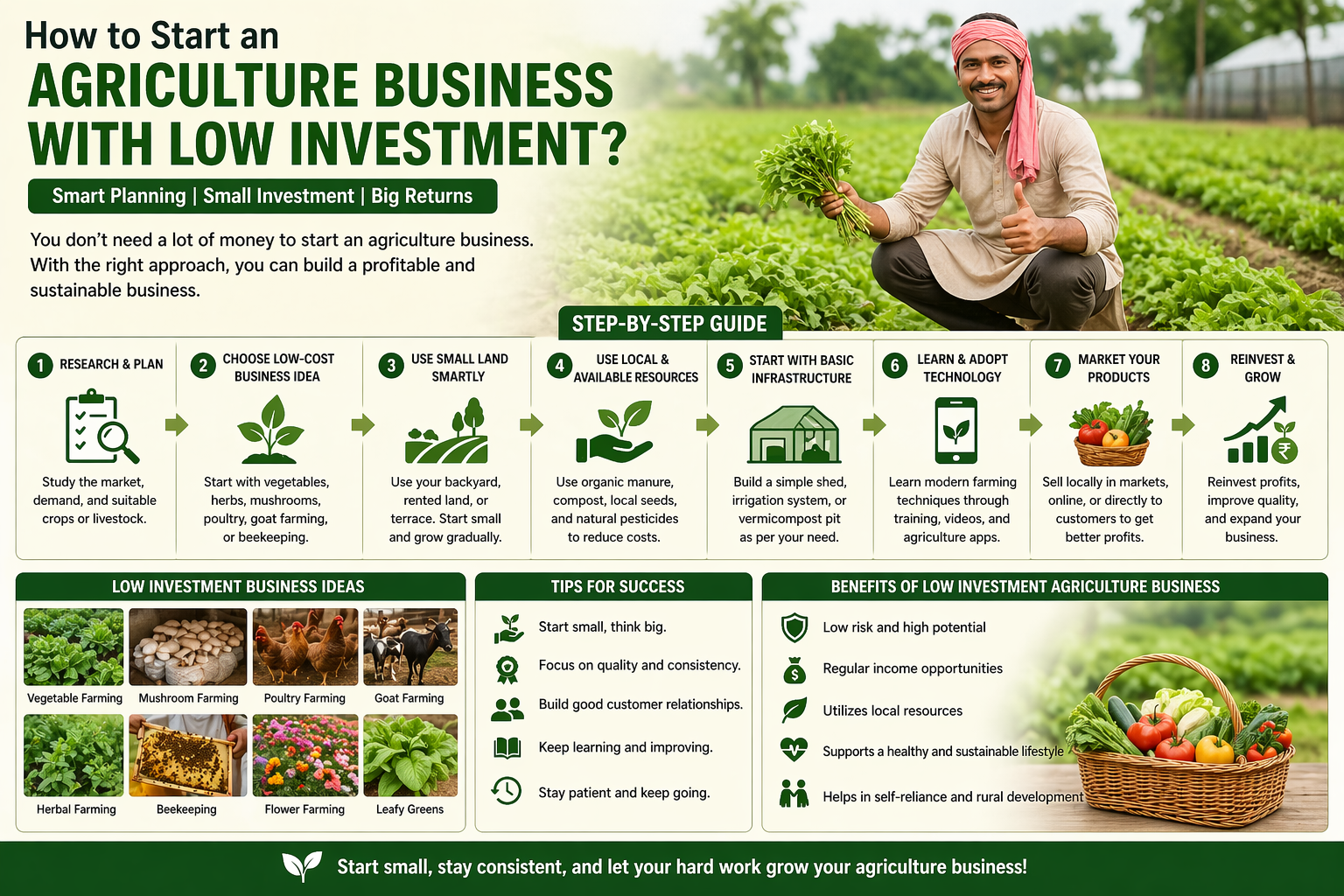
Agriculture remains one of the most profitable and sustainable business opportunities, especially when approached strategically with minimal capital. We can build a high-yield agricultural business by focusing on smart resource allocation, efficient planning, and selecting the right niche. With increasing demand for organic food, fresh produce, and sustainable farming, even a small investment can generate significant returns when managed correctly.
Understanding the Scope of Low-Investment Agriculture
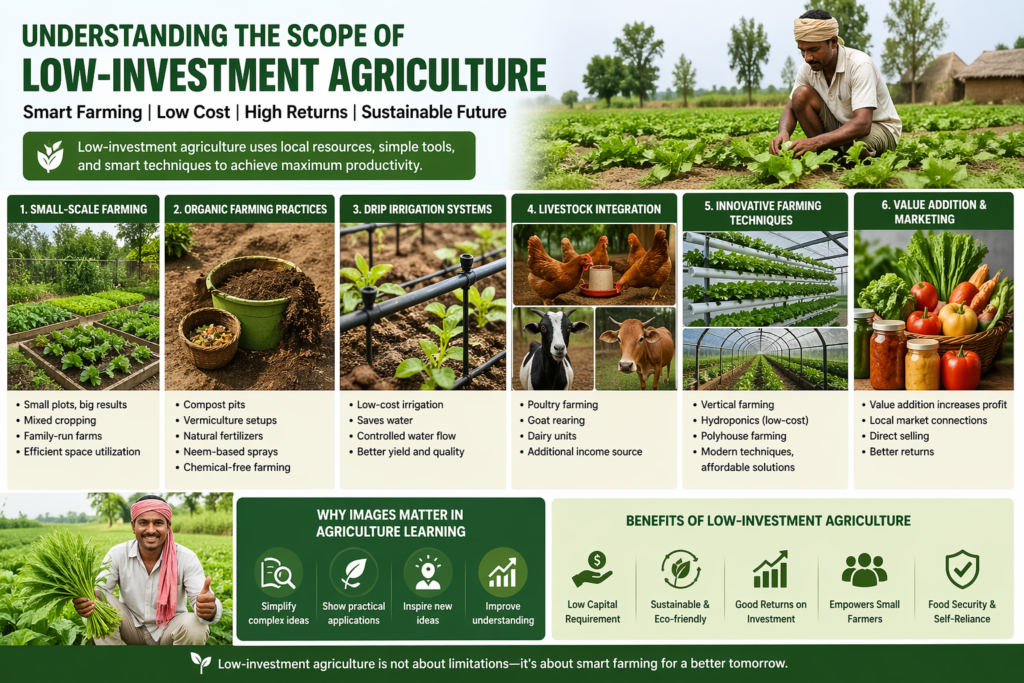
We begin by identifying areas of agriculture that require low initial capital but offer high returns. Instead of traditional large-scale farming, we focus on high-efficiency, small-scale ventures such as:
- Organic vegetable farming
- Mushroom cultivation
- Herbal plant farming
- Poultry farming
- Beekeeping (apiculture)
- Dairy micro-farming
These segments demand limited land, minimal infrastructure, and lower labor costs, making them ideal for beginners.
Selecting the Right Agricultural Business Model
Choosing the right model is the foundation of success. We evaluate based on budget, land availability, climate, and market demand.
1. Organic Farming Business
Organic farming is gaining massive popularity due to rising health awareness. We can start with leafy greens, tomatoes, chilies, and herbs. The investment is low as it avoids chemical fertilizers and focuses on natural compost and organic inputs.
2. Mushroom Farming
Mushroom cultivation is one of the most profitable low-investment agriculture businesses. It requires a small indoor space and controlled conditions. With minimal setup, we can achieve fast production cycles and high profit margins.
3. Poultry Farming
Starting a small poultry farm with 20–50 birds can generate consistent income. We can begin with local breeds, reducing costs while ensuring adaptability.
4. Hydroponic Farming
Hydroponics eliminates the need for soil and uses nutrient-rich water solutions. Though slightly technical, it requires less water, smaller space, and delivers faster growth, making it highly efficient.
Planning and Budget Allocation
Proper planning ensures that every rupee is utilized effectively. We divide the budget into:
- Land preparation or rental
- Seeds or livestock purchase
- Basic tools and equipment
- Water and irrigation setup
- Organic fertilizers or feed
We can start with as little as ₹10,000 to ₹50,000, depending on the chosen business. Cost-saving strategies include using recycled materials, local seeds, and community labor support.
Land Selection and Optimization
We do not need vast farmland to begin. Even a small plot, backyard, or terrace can be transformed into a productive agricultural unit.
- Choose land with good soil quality and water availability
- Ensure proper sunlight exposure
- Implement crop rotation and intercropping techniques to maximize yield
Urban farming using vertical gardening and container farming is also an excellent low-cost option.
Sourcing Quality Inputs at Low Cost
To maintain profitability, we prioritize cost-effective sourcing:
- Use locally available seeds and seedlings
- Prepare organic compost at home
- Partner with local farmers for bulk purchasing discounts
- Utilize government schemes and subsidies for agriculture startups
This reduces operational expenses while maintaining product quality.
Efficient Farming Techniques for Higher Yield
We adopt modern yet affordable techniques to increase productivity:
Drip Irrigation
This method saves water and ensures precise nutrient delivery to plants.
Mulching
Mulching helps retain soil moisture and reduces weed growth, minimizing maintenance costs.
Integrated Pest Management (IPM)
We avoid expensive chemicals by using natural pest control methods, such as neem oil and companion planting.
Crop Rotation
This improves soil fertility and prevents disease cycles, ensuring consistent production.
Marketing Strategies for Maximum Profit
Producing crops is only half the journey; selling them effectively ensures profitability.
Direct-to-Consumer Sales
We can sell directly through:
- Local markets
- Weekly farmer markets
- Door-to-door delivery
This eliminates middlemen and increases profit margins.
Online Selling
Leveraging digital platforms allows us to reach a broader audience. We can promote products through:
- Social media marketing
- WhatsApp groups
- Local e-commerce platforms
Subscription Models
Offering weekly vegetable boxes ensures recurring income and builds customer loyalty.
Value Addition for Increased Revenue
Instead of selling raw products, we can increase profits through value addition:
- Converting milk into cheese or yogurt
- Making pickle, jam, or dried herbs
- Packaging organic vegetables as premium products
This strategy significantly enhances income without major investment.
Government Support and Schemes
We take advantage of various government programs designed to support small farmers:
- Subsidies for irrigation systems
- Loans with low interest rates
- Training programs for modern farming techniques
- Financial assistance for startup agriculture businesses
These initiatives reduce financial burden and provide technical guidance.
Risk Management and Sustainability
Every business involves risks, but we minimize them through:
- Diversifying crops to avoid total loss
- Using weather-resistant farming techniques
- Maintaining a small emergency fund
- Practicing sustainable farming to ensure long-term productivity
Sustainability not only protects the environment but also reduces operational costs.
Scaling the Business Gradually
Once the business becomes stable, we expand strategically:
- Increase production capacity
- Introduce new crops or livestock
- Invest in better equipment
- Build a strong brand identity
Scaling gradually ensures controlled growth without financial strain.
Conclusion: Building a Profitable Future in Agriculture
Starting an agriculture business with low investment is not only possible but highly rewarding when executed with precision. By focusing on smart planning, efficient resource utilization, and strong market strategies, we can transform a small investment into a sustainable and profitable venture. The key lies in choosing the right niche, maintaining quality, and continuously adapting to market demands.